

At a time when US President Donald Trump maintains he is ready to make the major decision regarding Iran, the Islamic Revolutionary Guard Corps warns that if the Americans attack them again, big surprises await that will leave the entire world astonished. And among the surprises they are preparing are new weapons and new targets. And while Trump has scheduled a summit meeting with Arab leaders of the Middle East and the Persian Gulf tomorrow, Tuesday 22/9, without ruling out contacts with Iranian President Masoud Pezeshkian on the sidelines of the UN General Assembly, analysts are weighing scenarios pointing either toward a "Big Deal" or a "Big War." Against this backdrop, a question written on street banners in Tehran alongside images of anti-tank launchers, sniper rifles, assault rifles, and military equipment stands out: "Do you know how to use it?" The message is hard to misinterpret. Behind the imagery of weapons on the streets lies a much larger statement: Iran wants to convince Washington that the next round will be more costly, more widespread, and far harder to control.
Tehran takes the war to the streets
On September 18, Tehran hosted the largest state-organized mobilization display since the outbreak of the war. Men, women, teenagers, and members of the Basij appeared on the streets, many in military attire. Military equipment was displayed, women were seen carrying weapons, and even teenagers participated in the military-style mobilization. Iranian authorities spoke of more than 600,000 young volunteers within a single week and stated they aim to surpass one million. International media confirmed the scale of the show of force, but also noted that official registration numbers could not be independently verified. However, this does not negate the political message. Iran no longer presents defense as the exclusive responsibility of its armed forces. It is turning it into a matter of social mobilization.
The message: "You will not only fight the army"
The logic behind Janfada is perhaps more significant than the actual number of volunteers. Tehran is attempting to alter the opponent's calculations. In a limited war, planning can rely on destroying missile installations, command centers, air defense systems, and military infrastructure. However, in a country projecting the image of hundreds of thousands of citizens integrated into auxiliary security, communications, rescue, and military support structures, the problem becomes fundamentally different. According to organizers' data, only 26% of those registered chose purely military or security roles. The remainder are directed toward sectors such as rescue services, social care, media, and financial support. This points less to a conventional reserve army and more to an effort to construct a mechanism of national resilience.
The warning before the next strike
The mobilization acquires special importance because it coincides with a new period of extremely high tension. Iran has stated it possesses intelligence regarding a potential new American attack, and the Revolutionary Guards have warned of a severe response should further escalation occur. Washington, for its part, continues to exert military and economic pressure. Tehran wants its adversary to believe it is preparing precisely for a major attack. And in deterrence, the adversary's perception is itself a weapon.
Iran's real weapon is named Hormuz
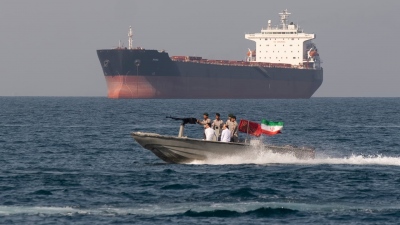
Iran's strongest card does not lie on the streets of Tehran. It lies at sea. The Strait of Hormuz has been transformed from a geographic reality into the central front of the war. The numbers are striking: according to data published by Reuters on September 21, only 17 essential commodity merchant ships passed through the strait over the weekend, compared to 37 a week earlier and roughly 125 daily before the war. This is perhaps the most tangible measure of the power that geography has acquired in this specific conflict. Iran does not need to capture a foreign capital to inflict global costs. Uncertainty in Hormuz is enough.
Geography became a strategic weapon
Tehran has managed to transition from being a "target" to being an interlocutor shaping the terms of the next day — from maritime routes to the reopening of the strait. This formulation is grounded in a physical fact: Hormuz has become so critical that even alternative methods of oil exportation, such as ship-to-ship cargo transfers, are now utilized to bypass part of the risk. The cost of these solutions is immense. Freight rates have skyrocketed, and the energy supply chain has become far more expensive and fragile.
The war moves to the US Treasury
There is also a second field where Tehran can point to measurable results: the financial cost to the United States. On September 15, the independent Congressional Budget Office calculated that US military operations against Iran had cost approximately $38 billion up to August 1. The sum includes munitions, material losses, operational expenditures, fuel, and additional flights. Even more critical is the warning regarding weapon stockpiles, which are depleting dangerously. The CBO notes that high consumption of air defense interceptor missiles leaves the US with reduced quantities for several years, and that such a deficit would become particularly severe in a potential conflict with an adversary possessing large numbers of ballistic and cruise missiles. This is precisely the type of war of attrition Tehran seeks to highlight. Not necessarily to destroy the adversary, but to make every subsequent step far more expensive.
Iran does not need to "win" in the classic way
Herein lies the core of the Iranian strategic narrative. The military superiority of the United States in air power, technology, and overall resources has not vanished. However, Iran is attempting to shift the war to fields where this disparity carries less weight: strategic choke points, missile stockpiles, energy costs, insurance, maritime transport, and the duration of the conflict. Every passing month without Tehran's strategic collapse reinforces its core argument: that American power can strike, but cannot easily impose a final political settlement. This does not automatically equate to "absolute dominance" by Iran. It means, however, that Tehran has succeeded in creating an arena where even the world's strongest military force pays a heavy price to continue.
The trap of the two straits
The picture becomes even more complex on the other side of the Arabian Peninsula. The Bab el-Mandeb has also been turned into a hotbed of instability. The Houthis have intensified their attacks, and developments in Yemen are placing additional pressure on maritime transit and Gulf nations. For Iran, this geographic alignment is strategically invaluable. When Hormuz is pressured, alternative routes acquire greater significance. When the Red Sea is under simultaneous pressure, the equation becomes vastly more difficult. Tehran does not control all these variables; however, it stands at the center of a regional web where any new escalation can quickly spill over from the military domain into energy, shipping, and the global economy.
And now Tehran points inward
There is, however, a second reading of the mass mobilization. The Basij force is not merely a defense mechanism. Historically, it has also been utilized for internal security and the suppression of anti-government protests. Therefore, creating hundreds or thousands of new organized units may simultaneously serve two needs: defense against an external attack and internal control during a period of economic pressure and social unrest. The Janfada material itself links military mobilization with social endurance, energy conservation, and state support. In other words, Tehran is preparing not only for a missile that might come from outside, but also for the internal shocks it will trigger.
The most alarming message is the one not yet spoken
The banners on the streets, the weapons, the volunteers, the Basij, the pressure on Hormuz, and the warnings from the Revolutionary Guards do not prove that a specific, secret plan for a major attack already exists. They do, however, demonstrate an organized effort to generate that exact uncertainty. And perhaps this is the most critical element of current Iranian strategy. Tehran wants every military staff planning a new strike to be forced to calculate not just how many targets it can destroy on night one, but what will happen in the second week, the second month, and the seventh month. How many interceptors will be required. What will happen in Hormuz. What will happen at Bab el-Mandeb. How much oil will cost. How many more American billions will be required. And how many Iranians will be ready to enter a defense framework that is no longer limited to the armed forces.
The battle for "dominance"
Tehran presents this reality as proof that it has inverted the terms of the war and now dictates part of the regional equation. This remains a political and strategic interpretation, not a settled outcome. What is indisputable, however, is different: after months of conflict, Iran remains capable of impacting critical maritime lanes, imposing heavy costs on the American war machine, and simultaneously organizing a new, massive mobilization structure domestically. That is why the imagery of Tehran's banners holds greater weight than a simple PR campaign. "Do you know how to use it?" The question is addressed to Iranians. The message, however, is intended primarily for Washington. If another attack occurs, Tehran wants to have already planted a single thought in its opponent's mind: that this time, the response may not be contained to a single front or a single night.
The Revolutionary Guards' warning
This, after all, was the latest warning issued by the Revolutionary Guards to the US. Specifically, they signaled that should they attack Iran again, a major surprise awaits them, as new weapons and new targets stand ready… Hossein Mohebi, a spokesman for the Guards, after asserting that the US has been humiliated, stressed that this is proven by the fact that despite possessing the world's largest naval power and presenting the protection of energy flows and freedom of navigation as a primary reason for its regional presence, the US failed to reopen the Strait. "America was unable to open the Strait of Hormuz. It brought all available assets to the region and failed. This constitutes a defeat," he stated. At the same time, he argued that Washington failed in its own self-stated objective of maritime security. "The country that was supposed to ensure security ultimately became a factor of insecurity," he said. According to him, prior to the start of American strikes, the Strait was open, whereas the interruption of shipping occurred after the US attack.
Ready for war
In today's edition of the Iranian newspaper Etemad, Mehdi Beakogli writes about the escalating confrontation between Iran and the United States. As he notes, US embassies in Abu Dhabi, Qatar, Jordan, Saudi Arabia, Israel, and elsewhere issued emergency security warnings officially calling on all American citizens not only to reconsider and avoid travel throughout the Middle East and West Asia, but also to remain alert for immediate fallout from potential flight cancellations, airspace closures, and surprise attacks on infrastructure facilities, including airports in Saudi Arabia and other countries. The warning goes beyond routine measures, as Washington maintains that interests, companies, and diplomatic missions linked to the United States could become targets of retaliation by pro-Iranian forces even outside the Middle East. The security assessment confirms that American intelligence evaluations regarding regional instability have worsened significantly and that they now treat the threat of asymmetric conflict capable of impacting strategic locations as severe.
The two scenarios
The current crisis in West Asia hangs between two specific scenarios: either Washington, under growing pressure related to fuel tankers, heightening security advisories, and the risk of failure in the November elections, will accept new regional realities and, by meeting Iran's seven conditions, create terms to restore understanding with Islamabad and reopen maritime transit routes, or, by insisting on unilateral policies, it will drive the current stalemate to an uncontrollable level of tension, triggering Iran's option to withdraw from the Nuclear Non-Proliferation Treaty (NPT) and leading to direct confrontation with US allies. Pezeshkian's visit to the United Nations and diplomatic moves by mediators in the coming days will determine whether the voice of diplomatic reason will prevail over the drums of war or whether the world must prepare for a more costly and unstable global order.
The forecast for an American attack on Iran
Mohsen Rezaei, secretary of Iran's Supreme National Security Council, stated in an interview with Al Jazeera that Tehran is in a state of serious defensive readiness and that, if attacked, it will strike US bases and interests in the region with even greater intensity. Iran is prepared for a "decisive war," and Donald Trump's threats, according to him, will yield no results. As he noted, Tehran is aware of the vulnerabilities of the US military and is now better prepared than in the past to counter American airstrikes. He added that the United States' withdrawal from the Memorandum of Understanding altered Tehran's calculations and that Iran decided to shift its strategy toward Washington.
Hell will break loose
One of the most important points in Rezaei's statements concerned maritime developments. As he said, Iran recently tested an anti-ship missile near an American aircraft carrier, a move that, if confirmed, demonstrates the growing importance of the naval front in the confrontation between the two nations. In tandem with Rezaei's statements, the Khatam al-Anbia Central Headquarters also issued a stern warning. Referring to what it described as a "green light from certain regional countries" to American officials to resume actions against Iran, the headquarters stated that in the event of a US attack, staging bases and US assets in the region will be targeted without restraint. This warning was aimed not only at Washington but also at countries that continue to pursue a double standard regarding US actions against Iran. As stated, those countries will be deemed complicit and should expect no restraint from Iranian armed forces.
The Middle East on the brink of the abyss
Writing in Iranian Development, Tahmours Gilani noted: What emerges from international news agency reports is that the Middle East stands at one of the most critical junctures in its history. Donald Trump's premature return from Camp David to the White House following missile strikes in Riyadh indicates that Washington evaluates the situation as a "crisis." Trump finds himself caught between pressure from Arab allies — Saudi Arabia and Qatar — who fear their oil and gas facilities could be targeted, and pressure from Israeli hardliners who wish to finalize operations across northern and central fronts. The reality is that the threat of a "major event" could represent Trump's final move within the framework of coercive diplomacy. As Foreign Policy analysts have warned, initiating a war may lie within the hands of the United States, but ending it will not necessarily remain under Washington's control. Relying on the "end of restraint" and activating diplomacy on the ground, Iran has made clear that any military action could turn into a prolonged conflict with unpredictable costs for the global economy. In the coming days, the UN General Assembly session and Trump's meetings with Gulf Cooperation Council leaders will determine whether the world will witness a "grand bargain" or if the Middle East will sink into the flames of a large-scale military event.
www.bankingnews.gr





Σχόλια αναγνωστών